
 JayseeOwner, HAS
 ToniHAS
 GraceFront desk
 FrancescaFront desk

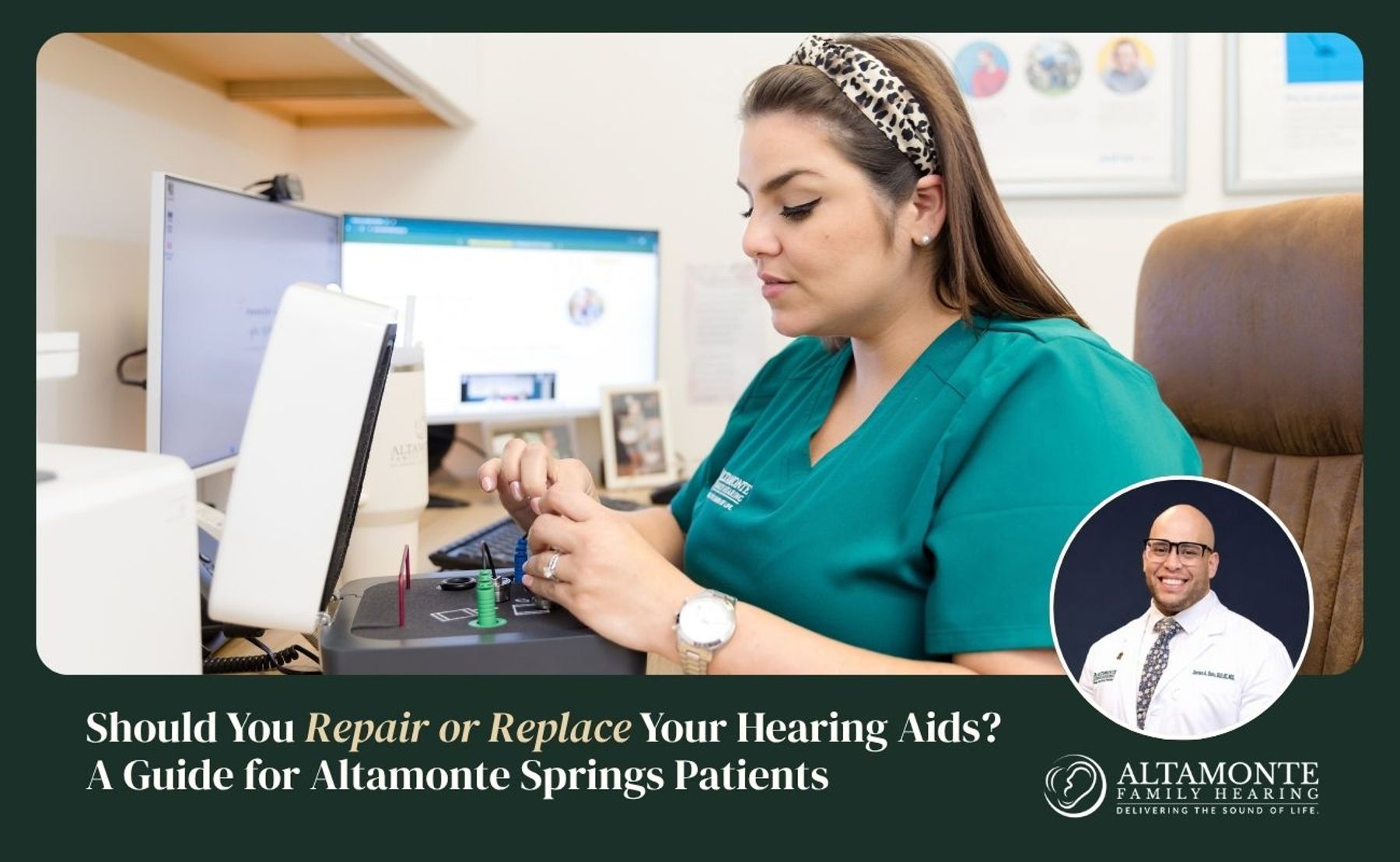
After a long Central Florida summer, you may notice that your hearing aids aren't performing the way they did in the spring. Heat, humidity, and perspiration are hard on even well-built devices, and fall is a practical time to decide whether yours need a repair or a replacement.
How Florida Summers Affect Hearing Aids
Moisture is one of the most common causes of hearing aid problems. Humid air and perspiration can enter the microphone ports and the receiver, and over time moisture can corrode charging contacts and internal circuitry. Sunscreen, skin oils, and earwax also collect on the receiver and its wax filter, which reduces output or blocks sound altogether. Because these changes develop gradually, sound quality can decline for months before you notice.
Signs of Wear on Phonak, Starkey, and Signia Hearing Aids
Phonak, Starkey, and Signia all build rechargeable receiver-in-canal (RIC) hearing aids, and their current flagship lines (Phonak Audéo EON Sphere, Starkey Omega AI, and Signia Pure Charge&Go MaX) include this style. In a RIC hearing aid, the receiver sits inside the ear canal, which makes it the component most exposed to moisture and earwax. Common signs include:
- Weak, muffled, or distorted sound. This often points to a clogged wax filter or a receiver damaged by moisture or debris.
- Sound that cuts in and out. A damaged receiver wire or a loose connection can cause intermittent sound, particularly when you turn your head or chew.
- Shorter battery life. Lithium-ion batteries gradually lose capacity as they age. If hearing aids that once lasted all day now run down by late afternoon, the battery or charging contacts may need attention.
- Charging problems. Hearing aids that don't seat securely in the charger or show unusual indicator lights may have dirty or corroded contacts.
- New whistling or feedback. A worn dome, a change in fit, or a cracked housing can allow amplified sound to leak back into the microphones.
Starkey's Omega AI RIC RT and mRIC R models include LED indicator lights that confirm power and Bluetooth connection, which can help you tell whether a problem involves charging or connectivity.
What Happens During a Repair Evaluation
A repair visit starts with a thorough cleaning and inspection of the receiver, domes, wax filters, microphone ports, and charging contacts. Electroacoustic analysis can be used to measure the hearing aid's output and frequency response and compare them with the manufacturer's specifications. This tells us whether the device is performing as designed or whether a component has degraded.
Repairs such as replacing a receiver, dome, or wax filter are usually straightforward. Damage to internal components or the rechargeable battery often requires service at the manufacturer's repair facility.
If the hearing aids test well, the issue may be a change in your hearing, in which case they may need to be reprogrammed to updated prescriptive targets based on a new hearing evaluation. You can learn more on our hearing aid repair page.
When Replacement Makes More Sense
Hearing aids are commonly expected to last about three to seven years, depending on the technology, daily conditions, and care. Replacement often becomes the better investment when:
- The hearing aids are near the end of that range and have needed repeated repairs.
- Your hearing has changed beyond what the current devices can be programmed to address.
- The manufacturer no longer supports repairs for your model.
- You want capabilities your current devices lack, such as improved speech-in-noise processing or Auracast streaming.
Phonak reports that Audéo EON Sphere is 25% smaller and 20% lighter than the previous Sphere generation and adds WindBlock 2.0 for outdoor listening. Starkey states that Omega AI's waterproof coating on its rechargeable models was tested to last 10 times longer than previous coatings. Signia's Pure Charge&Go MaX uses four deep neural networks working together to analyze speech, noise, the listening environment, and the wearer's own voice.
Timing Your Decision Before Year-End
Many insurance plans that include a hearing aid benefit renew on a calendar-year basis, and unused benefits often do not carry over. Reviewing your benefit this fall leaves time to make an informed decision before December. We work with most insurance plans.
Hearing Aid Repair in Altamonte Springs
Altamonte Family Hearing provides hearing aid repair in Altamonte Springs from our family-owned practice inside the One Senior Place building at 715 Douglas Ave, Suite 45. We work with six of the leading hearing aid manufacturers in the world, including Phonak, Starkey, and Signia. Our team provides care in English and Spanish, and in-office hearing evaluations are complimentary.
Walk-in hours are available daily from 1:00 to 2:00 pm, or call us at 407-949-6737 to schedule a repair evaluation or a complimentary hearing evaluation.